TrustMed Digital

TrustGuide

Guideline intelligence your trust can govern.

TrustGuide answers clinicians' questions from your ratified guidelines, checks each dose against its source, says when the guidance does not cover a question, and gives the trust an auditable record to govern and learn from.

In development. Not yet available for clinical use. Pilots start with evaluation on synthetic scenarios.

Captioned demo on a fictional trust, about 3 minutes. All guidelines and usage shown are synthetic.See the governance views

For the trust

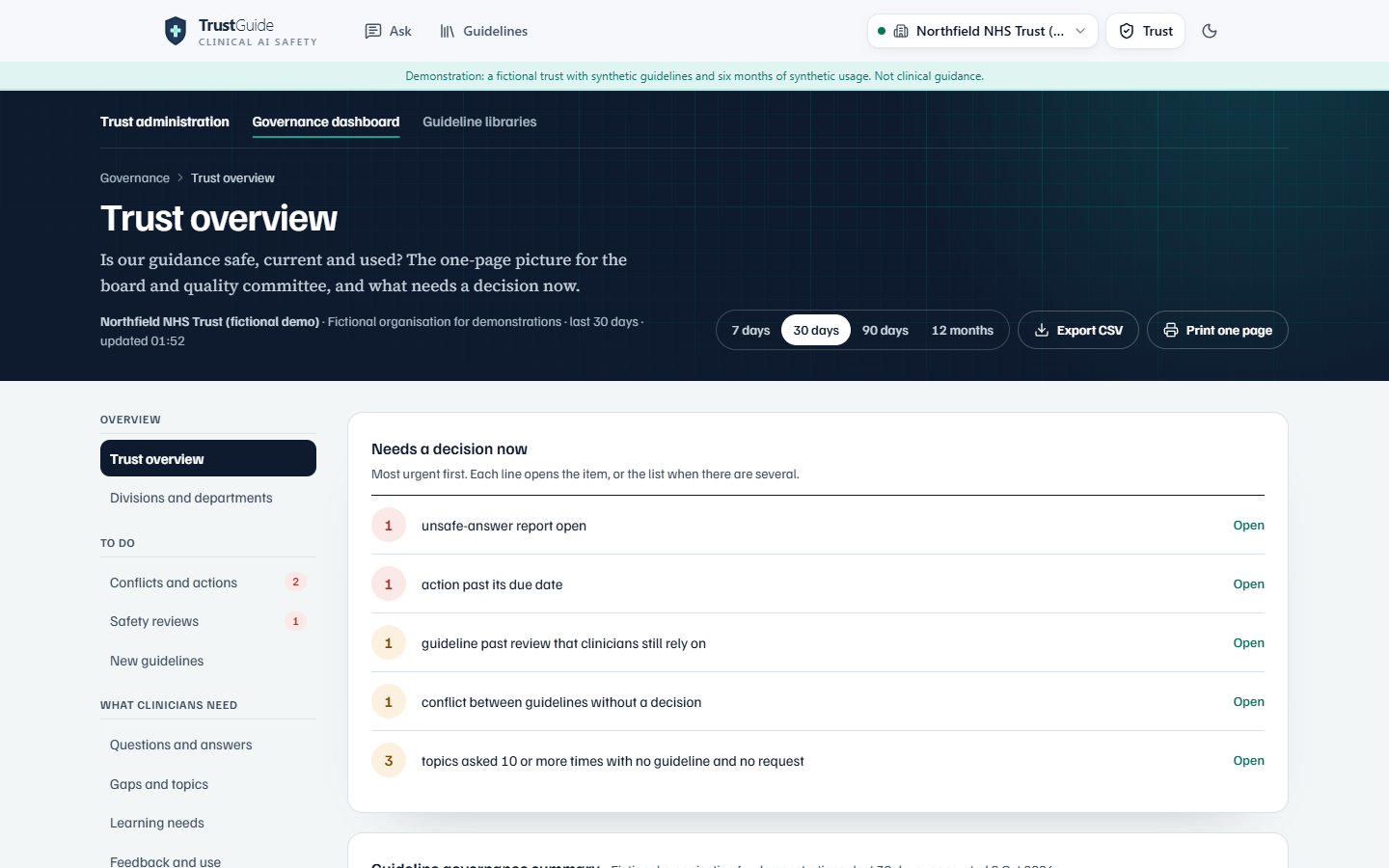
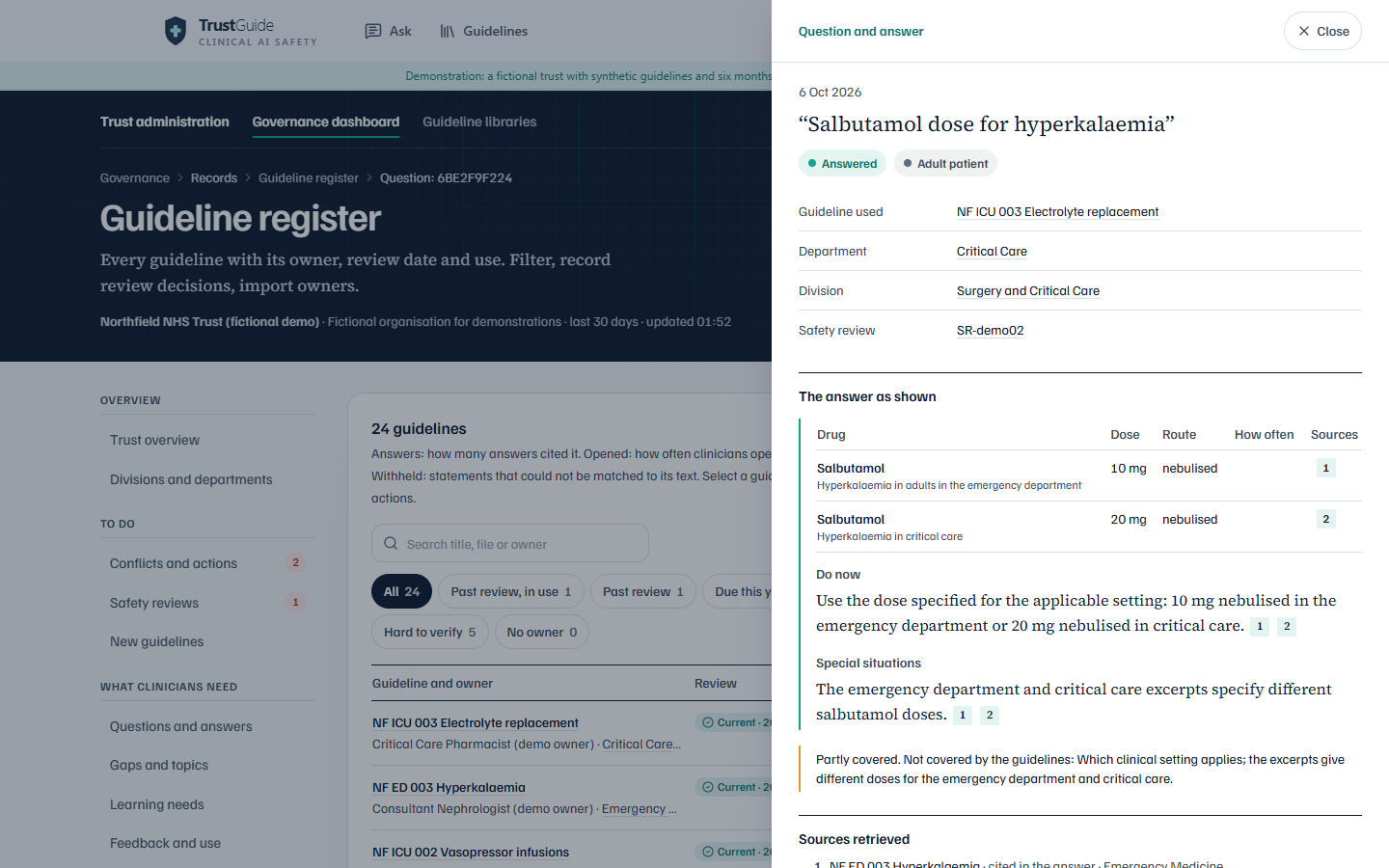
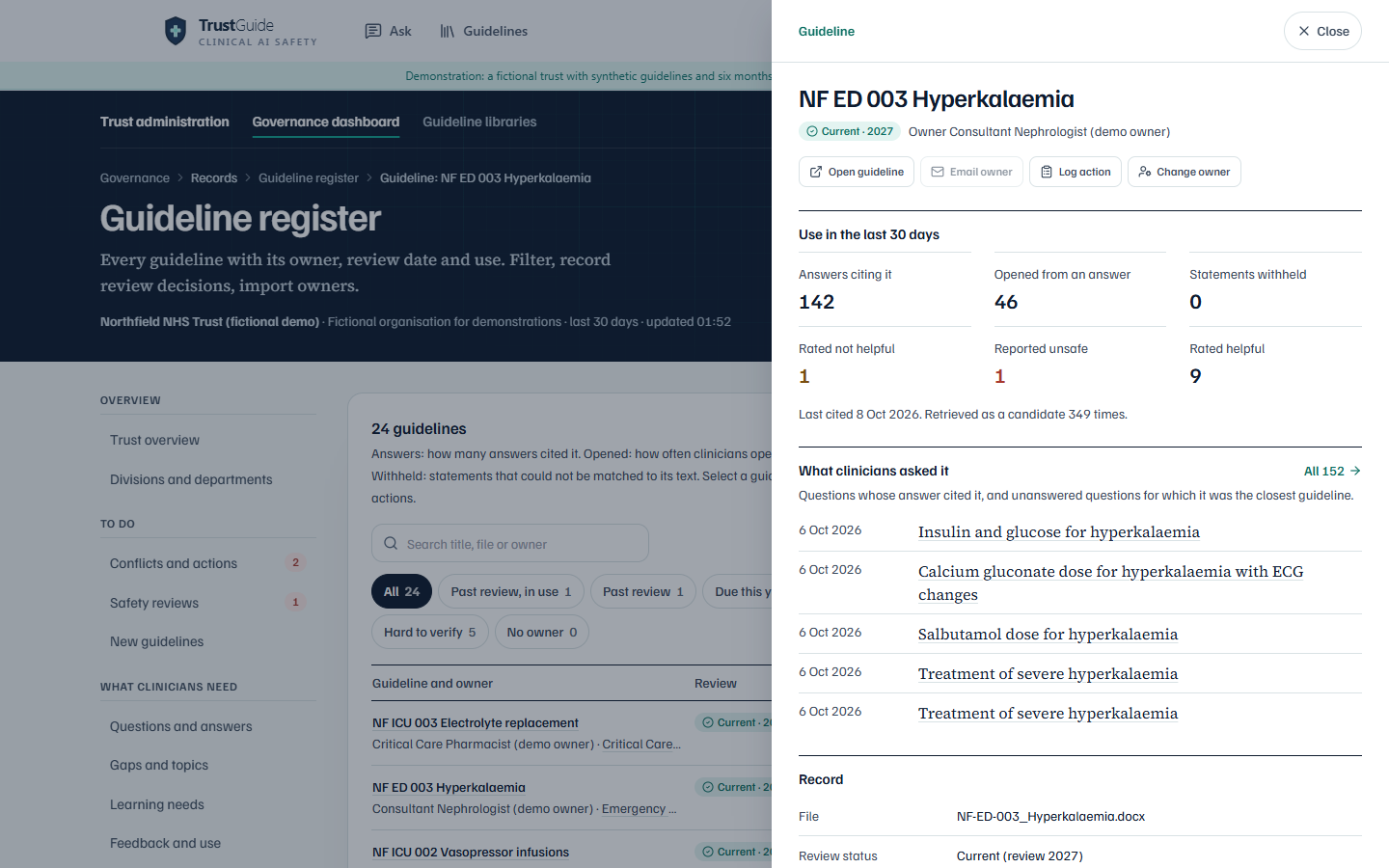
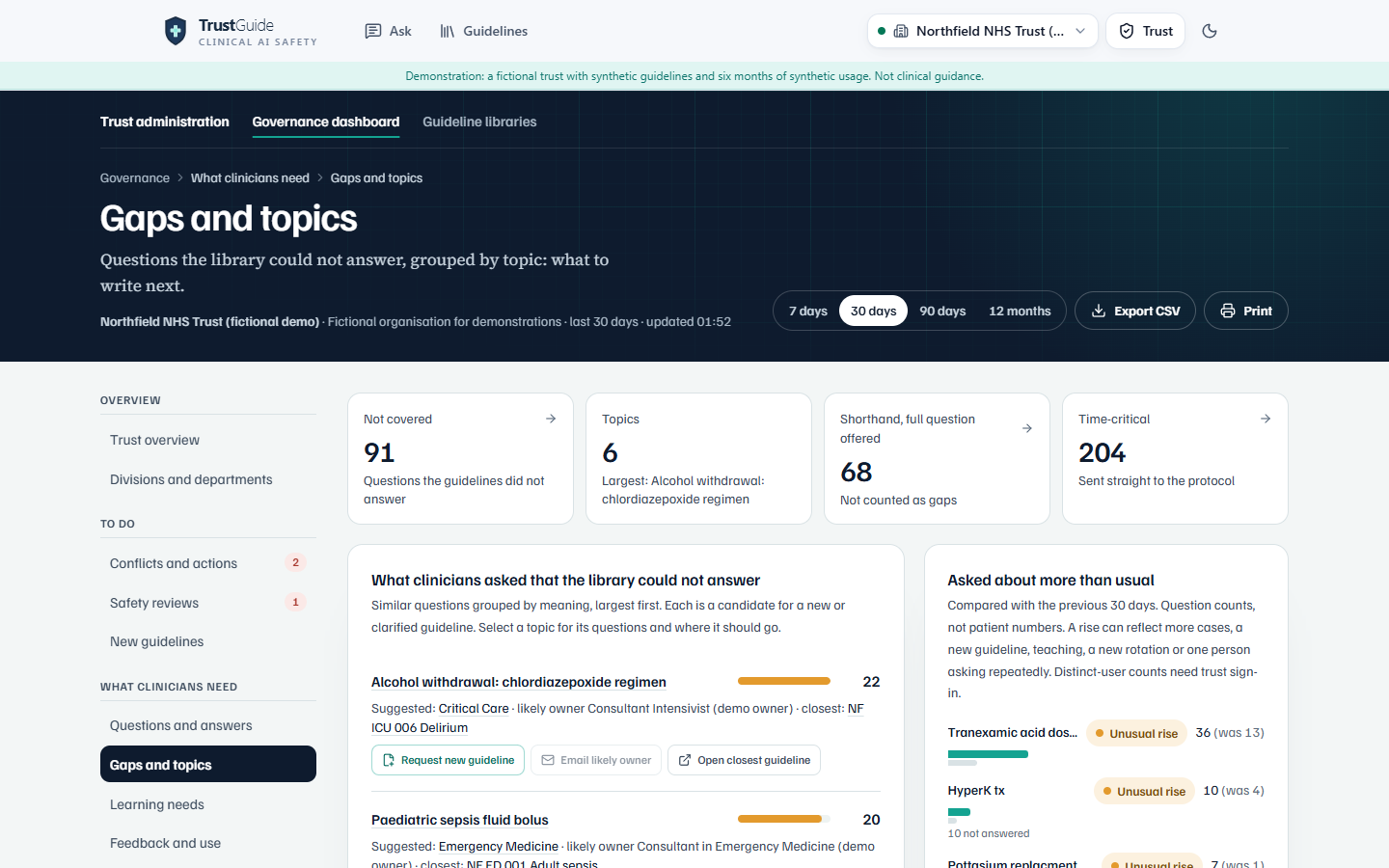
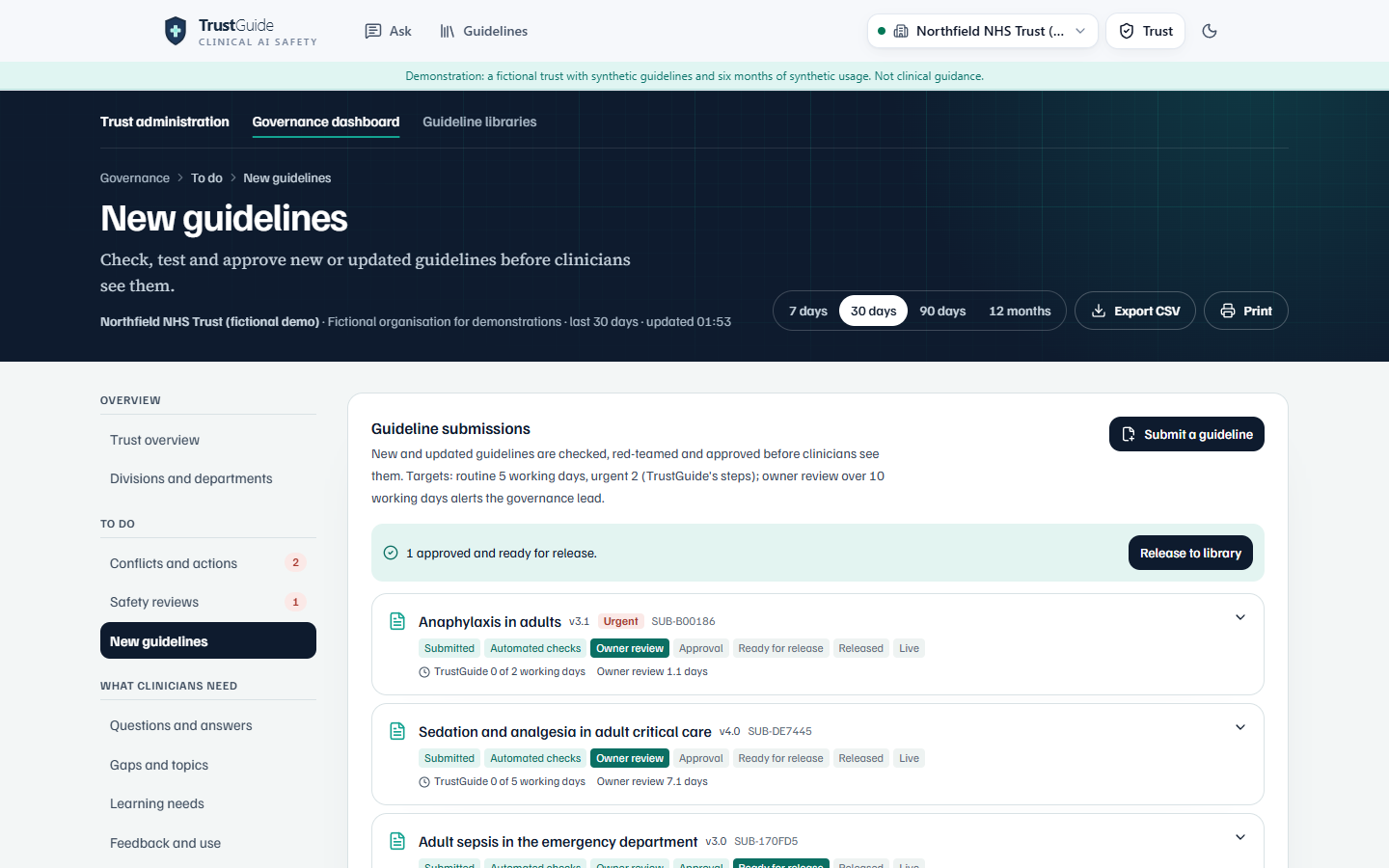
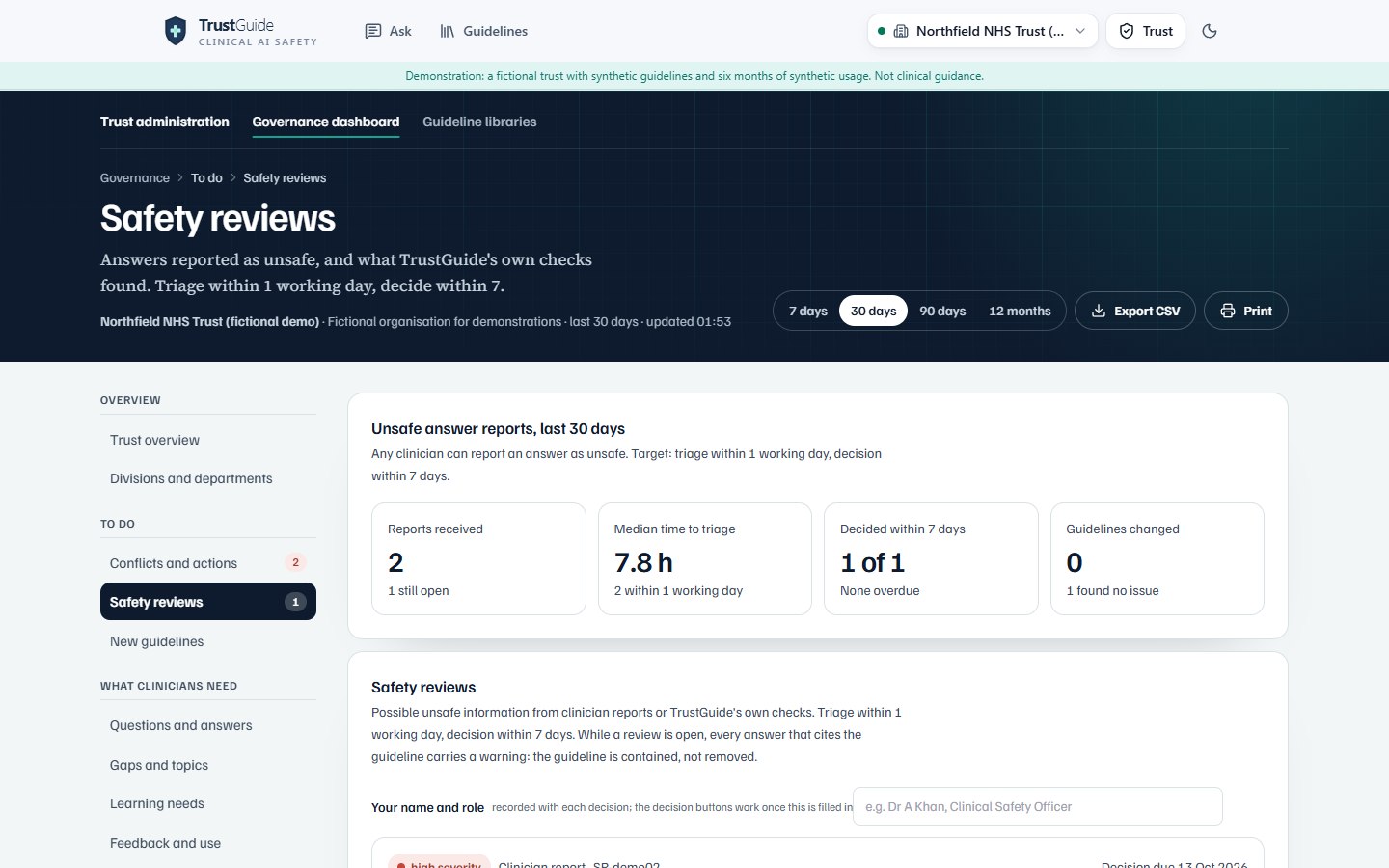
The screens your governance teams will use.

For the board, divisions, education leads and clinical safety, built from records TrustGuide already keeps. No extra data entry for clinicians.

Trust overview opening with the items that need a decision now
Trust overview. What needs a decision now, then guideline currency, use and risk by division, ready for the monthly report. Every line opens the detail.

Screens from Northfield NHS Trust, a fictional demo trust with synthetic guidelines and usage.

For clinicians

Built for the pace of acute care.

The aim is the speed of a chatbot with the discipline of reading the protocol, so clinicians choose it over a personal account.

Actions first, with the passage one tap away

What to do now, then doses, targets and when to escalate, framed for the setting. Every number is matched to the guideline it cites, with its review date. Median answer time was about 7 seconds in internal testing on synthetic questions.
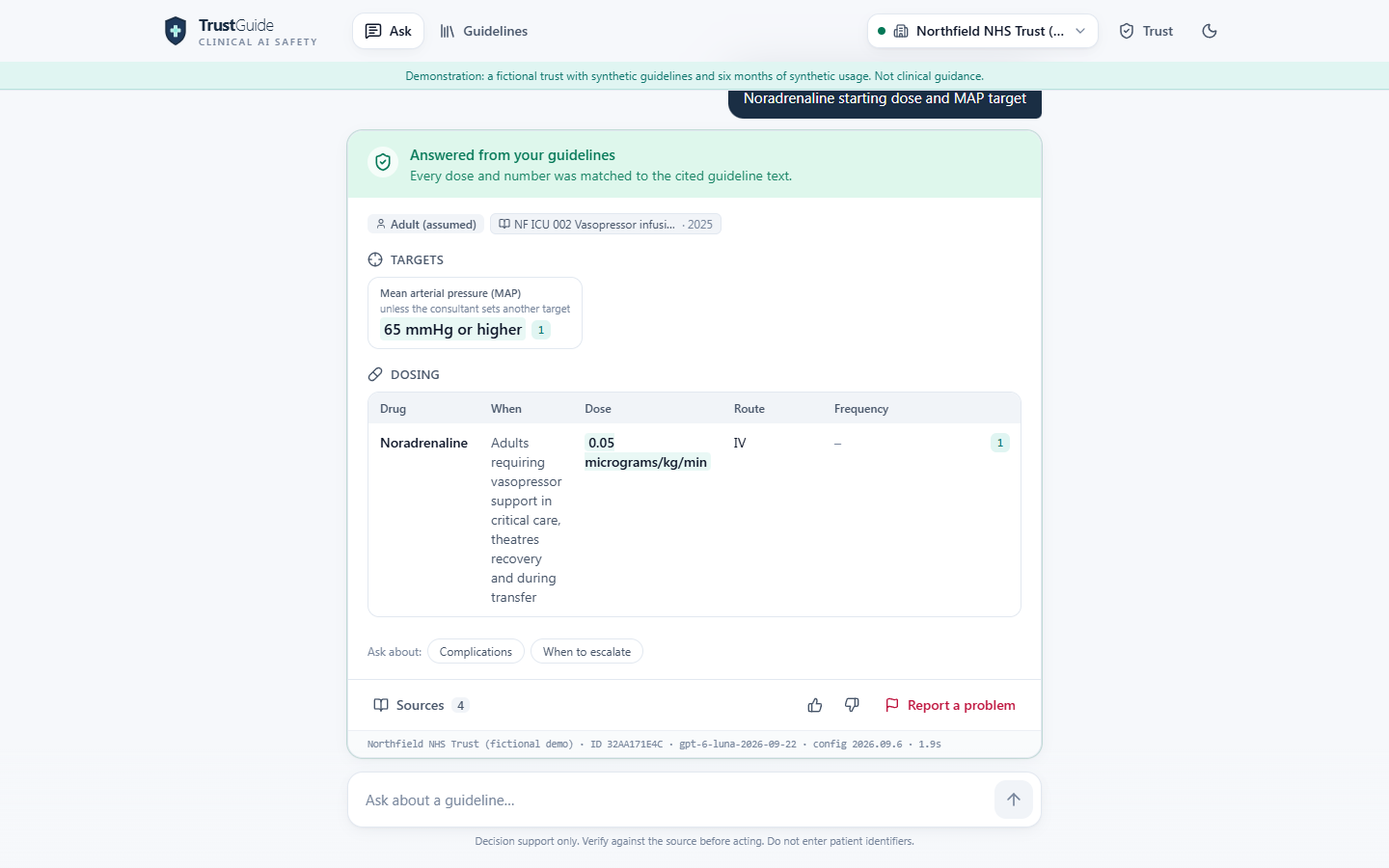
TrustGuide answer with immediate actions, a dose table and escalation
A verified answer from a fictional trust's guideline.

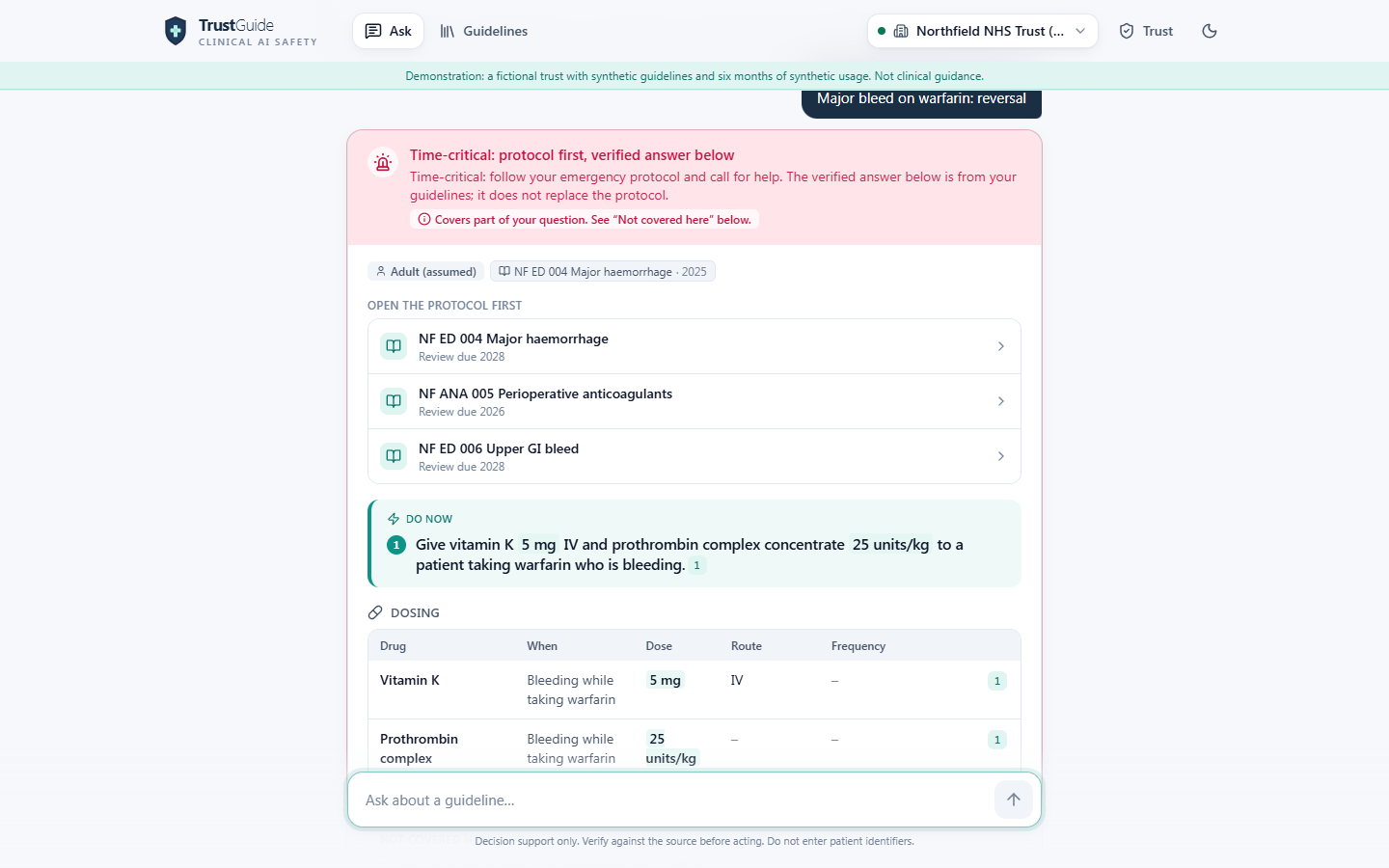
Emergency protocol first

For time-critical topics such as major haemorrhage, the trust's protocol appears instantly, before the full answer. Resuscitation algorithms are never summarised.

Time-critical answer with the protocol shown first
Major bleed on warfarin: protocol first, verified reversal doses below.

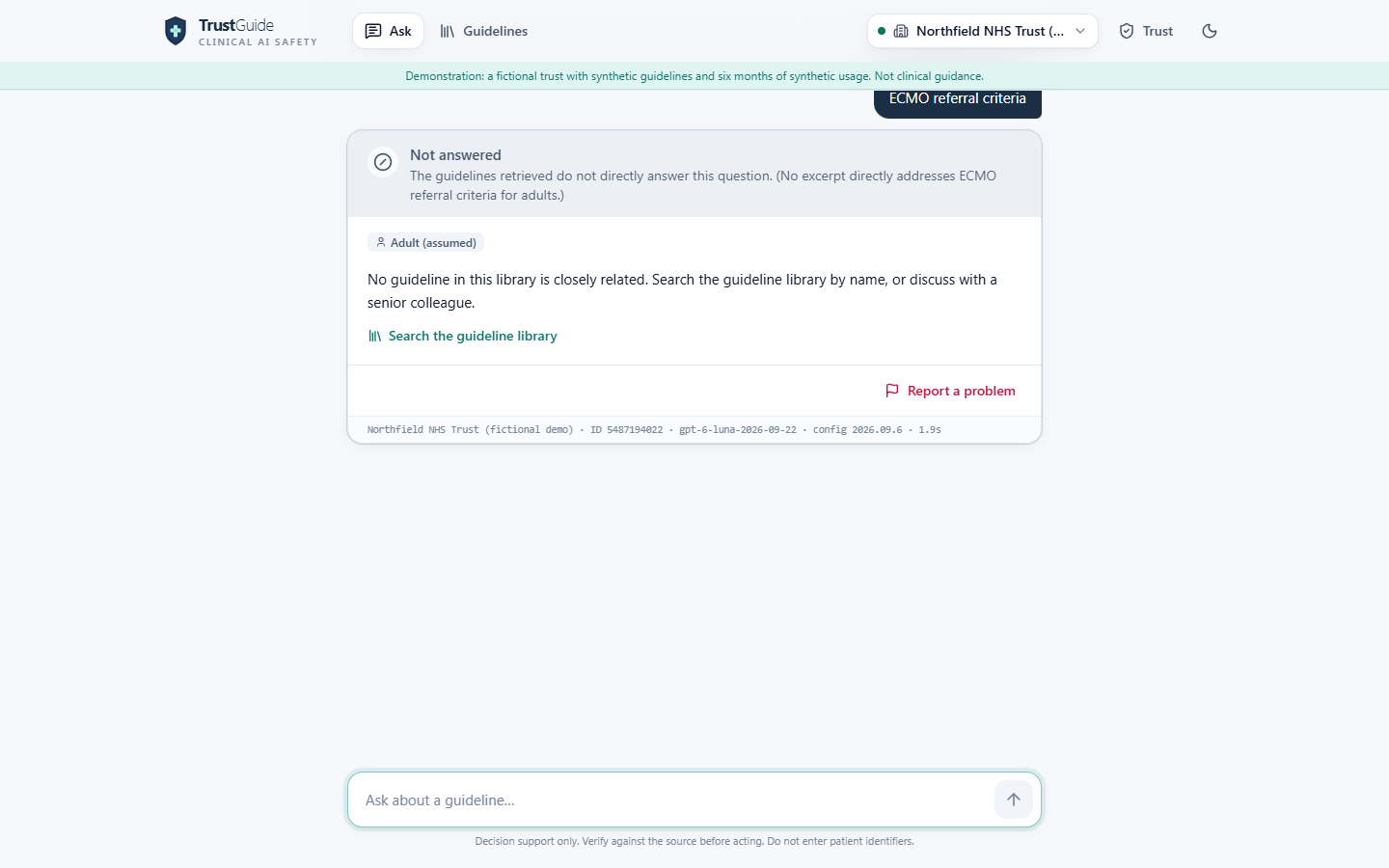
It knows when not to answer

If your guidelines do not cover a question, TrustGuide says so plainly and points to escalation. It never fills the gap from unrelated guidance, and every gap is logged for the owner.

TrustGuide saying the guidelines do not cover ECMO referral
ECMO referral is not covered by this fictional trust's guidelines, so TrustGuide says so.

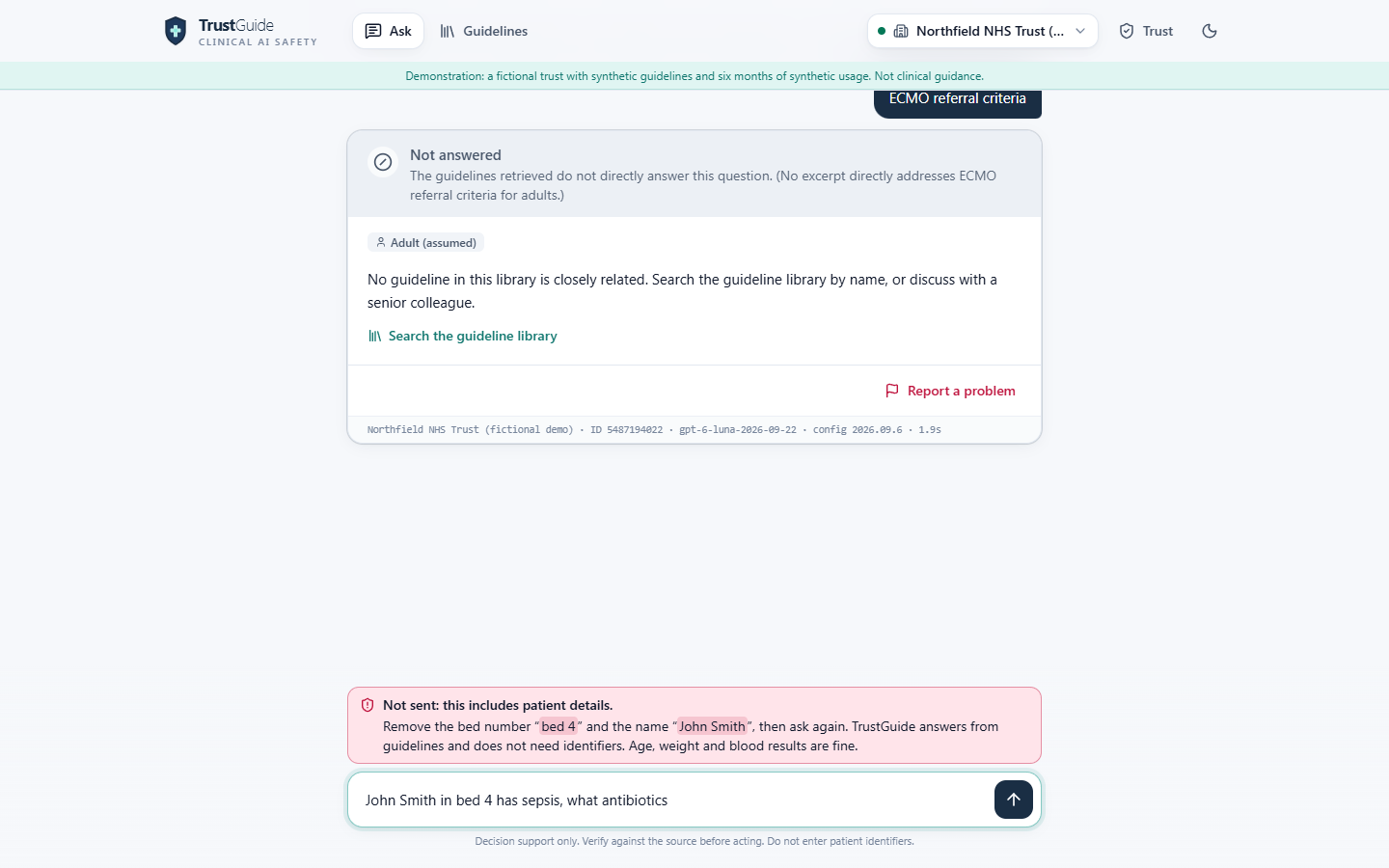
Patient details never leave the screen

A name with a bed number, or an NHS number, is flagged as the clinician sends, and the question is not sent or stored. There is no "send anyway".

TrustGuide blocking a question containing a patient name and bed number
A question with a name and bed number is blocked (synthetic example).

Compared with today

What your trust has now, and what changes.

CapabilityIntranet PDFsGeneral AI chatbotsGuideline appsTrustGuide
Answers from your ratified guidelinesYes, if foundNoYesYes, only those
Direct answer to a clinical questionNo, read the documentYesUsually search, then readYes, with the passage
Every dose checked against the sourceNot applicableNoNot applicableYes, or withheld
Says when guidance does not cover itNoRarelyEmpty searchYes, and logs the gap
Flags conflicting local guidelinesNoNoUsually notYes
Audit trail of questions and answersNoNoUsage analyticsTamper-evident log
Governance of guideline currency and ownersManualNoVariesBuilt in

Comparison by category, based on typical products. Individual products differ. TrustGuide entries describe its design; independent evaluation follows.

Safety, security and regulation

Designed to pass the questions your CSO, IG lead and CIO will ask.

Evidence is available on request, including the hazard log, intended purpose, DTAC pack and a data handling summary covering hosting, retention and the model provider. DCB0129 is the standard for manufacturers, which we follow. DCB0160 is the standard for the trust deploying a system, which we help you evidence.

Implemented

  • Clinical risk management (DCB0129)Hazard log maintained with every release, each control tested automatically. Pilots include evidence to support your own DCB0160 assessment.
  • No patient dataAnswers come from guidelines only. Names and NHS numbers typed by mistake are detected and blocked before the question is sent, stored or passed to the model.
  • Tamper-evident audit logOnly approved releases can run, and the log cannot be altered without detection.
  • Sign-in, roles and separationMulti-factor sign-in, five roles, and each organisation sees only its own libraries.
  • Internal safety testingA clinical safety test set runs on every release and is reviewed clinically. Independent evaluation follows.

In development

  • DTAC evidenceDrafted across all five domains.
  • Cyber EssentialsIn preparation, with a penetration test before any live pilot.
  • Medical device pathwayIntended purpose documented. Regulatory classification and MHRA route to be confirmed with each pilot trust before any live clinical use.
  • Service evaluationMock-use evaluation with acute care clinicians on synthetic scenarios.

Pilot

Start with one department and your own guidelines.

  1. Demonstration

    A live session for your CCIO, CSO and IG lead on a fictional trust.

  2. Your guidelines

    We load one department's ratified guidelines and your owners check how TrustGuide reads them.

  3. Evaluation

    Clinicians test it on synthetic scenarios before anyone relies on it.

  4. Governed pilot

    Live use only after the safety, security and regulatory steps on this page are complete, and only if your trust chooses it. A monthly governance report from the first month.

See what your clinicians need from your guidance.

Request a 30-minute demo